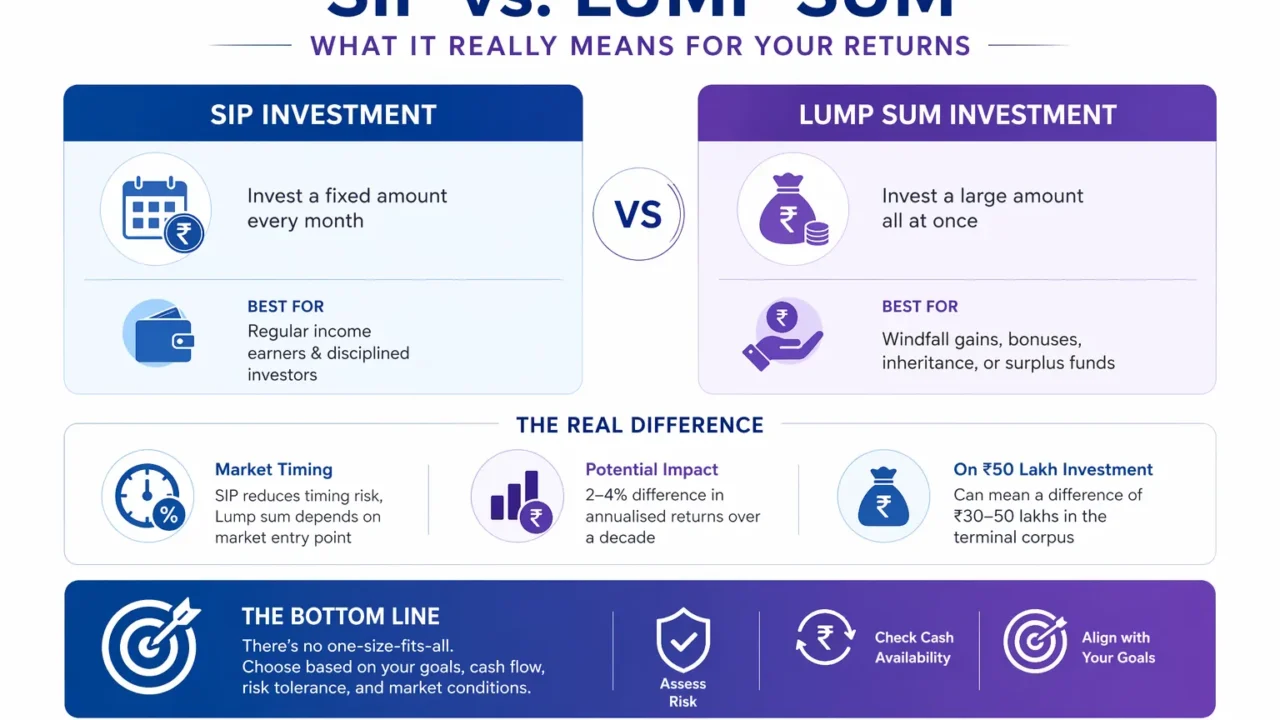
Got a year-end bonus of ₹1 lakh sitting in your account? Now you’re stuck deciding: dump it all into a mutual fund today, or spread it out over the next twelve months? This exact dilemma — SIP vs lump sum — comes up constantly, and the honest answer is: it depends more than most articles admit.
The Basic Difference Between the Two
SIP (Systematic Investment Plan) means investing a fixed amount at regular intervals, usually monthly. Lump sum means investing the entire amount in one go. The SIP vs lump sum debate essentially comes down to how you handle market timing risk.
SIPs average out your purchase price over time — you buy more units when prices are low, fewer when high. Lump sum bets everything on a single entry point.
When Lump Sum Actually Wins
Historical data on Indian equity markets shows lump sum investing tends to outperform SIP in roughly 60-65% of rolling time periods, mainly because markets trend upward over long horizons more often than they crash.
If you’re investing a bonus or inheritance and markets have recently corrected — say, after a 15-20% drop — lump sum can capture that recovery faster than a staggered SIP would.
When SIP Makes More Sense
If you don’t have a large sum sitting idle and instead invest from monthly salary, SIP isn’t even really a choice — it’s just how investing naturally happens. But even with a windfall, SIP (or a staggered approach) makes sense when:
- Markets are at all-time highs and feel overextended
- You’re emotionally uncomfortable watching a large sum drop 10% overnight
- You want discipline without needing to actively monitor entry points
I’ve done both over the years, and honestly, the emotional comfort of SIP matters more than people give it credit for. A 20% notional loss on a lump sum investment can genuinely mess with your sleep.
[link to related guide on how to start investing here]
A Middle Path: STP (Systematic Transfer Plan)
Many financial advisors recommend a middle ground for lump sum amounts: park the money in a liquid fund first, then use an STP to transfer it into equity funds over 6-12 months. This captures most of lump sum’s return advantage while reducing single-point timing risk.
This is actually what I’d suggest for most people with a sudden windfall, rather than picking strictly between SIP and lump sum.
Real Number Example
Say you invest ₹1,20,000 either as a lump sum or as ₹10,000/month SIP over 12 months in an equity fund averaging 12% annual return.
- Lump sum, invested at the start of the year: benefits from a full 12 months of compounding on the entire amount
- SIP, spread over 12 months: benefits from rupee-cost averaging but has less time in the market for later installments
In a rising market, lump sum usually edges ahead. In a volatile or declining market, SIP typically loses less.
Factors That Should Actually Guide Your Decision
- Your risk tolerance — genuinely, not what you think it “should” be
- Current market valuation levels (high P/E ratios suggest more caution)
- Whether this money has a specific near-term goal or is long-term wealth building
- Your ability to stay invested without panic-selling during a dip
Common Mistakes in the SIP vs Lump Sum Decision
- Choosing lump sum purely because “everyone says markets always go up long term”
- Starting a SIP but stopping it the moment markets fall, defeating the entire averaging benefit
- Ignoring that SIP works best with a long horizon — a 6-month SIP barely averages anything meaningful
- Not considering STP as a practical middle ground
[link to related guide on mutual fund direct vs regular plans here]
FAQs
Is SIP always safer than lump sum? Not exactly safer, but it does reduce timing risk. Over long periods in a consistently rising market, lump sum can outperform.
Can I do both SIP and lump sum together? Yes, many investors run ongoing SIPs from salary while also making occasional lump sum investments during market dips.
What’s the minimum period for a SIP to be effective? Most advisors suggest at least 3-5 years for equity SIPs to meaningfully benefit from rupee-cost averaging and compounding.
Does lump sum work for debt mutual funds too? Yes, since debt funds are less volatile, the timing risk of lump sum investing matters less compared to equity.
Is STP better than a direct lump sum investment? For large, one-time sums going into equity, STP is often considered a safer middle path by reducing single-point entry risk.
Conclusion
There’s no universal winner in the SIP vs lump sum debate — it genuinely depends on market conditions, your risk appetite, and how the money came to you in the first place. For most people sitting on a windfall, an STP-based staggered approach offers a reasonable balance.
Whatever you choose, the worst option is doing nothing and leaving that bonus sitting in a savings account earning next to nothing for another year