“I’ll start investing once I earn more.” I’ve heard this line from at least a dozen friends over the years, and honestly, I said it myself for longer than I’d like to admit. The truth is you don’t need a big salary to begin — you need to know how to start investing with whatever amount you can actually spare, even if that’s just ₹500 a month.
Why ₹500 Is a Perfectly Valid Starting Point
You can start investing with as little as ₹500 a month through mutual fund SIPs. Most fund houses in India have removed the old ₹5,000 minimum barrier, making it genuinely possible to build investing habits before you can afford larger amounts.
The point of starting small isn’t the money itself — ₹500 won’t make you rich. It’s building the habit and getting comfortable watching markets move without panicking.
Step 1: Get Your Basic Documents Ready
Before anything else, you’ll need:
- PAN card
- Aadhaar card linked to your mobile number
- A bank account for auto-debit
- Completed KYC (most apps now do this digitally in under 10 minutes)
If you’ve never invested before, you’ll need to complete KYC once through any registered platform — after that, it’s valid across all mutual funds and most brokers.
Step 2: Pick a Platform
Apps like Groww, Zerodha Coin, Kuvera, and Paytm Money let you start SIPs directly, often with zero commission on direct mutual fund plans. Direct plans typically give better returns than regular plans over time since there’s no distributor commission eating into your returns.
[link to related guide on direct vs regular mutual funds here]
Step 3: Choose the Right Fund for a Small SIP
For a first-time investor starting with ₹500, index funds or large-cap mutual funds are usually a sensible starting point. They’re less volatile than mid-cap or small-cap funds, which matters when you’re still getting used to seeing your investment value fluctuate.
A Nifty 50 index fund, for instance, simply tracks India’s top 50 companies and doesn’t require picking individual stocks or guessing fund manager performance.
Step 4: Automate It and Forget About It
Set up an auto-debit SIP so ₹500 gets deducted on a fixed date every month, ideally right after salary credit. This removes the decision fatigue of “should I invest this month” — the money just moves automatically.
I started my own first SIP at ₹1,000 back when I was earning far less than I am now, and honestly the habit mattered more than the return in those early years.
Step 5: Increase the Amount Gradually
A practical approach many advisors recommend is the “SIP top-up” — increasing your monthly SIP by 10% every year as your income grows. Starting at ₹500 and stepping up gradually can build a meaningfully larger corpus than staying fixed at ₹500 for years.
Most SIP platforms now let you set this top-up feature automatically, so you don’t need to manually adjust it each year.
What ₹500 a Month Can Actually Grow Into
At a conservative 10% annual return, ₹500 invested monthly for 20 years grows to roughly ₹3.8 lakh — from a total invested amount of just ₹1.2 lakh. Increase that SIP gradually as your income rises, and the numbers shift dramatically higher.
Mistakes First-Time Small Investors Make
- Stopping the SIP the moment markets dip, instead of treating it as a buying opportunity
- Chasing high-return small-cap funds too early without understanding the volatility
- Withdrawing the investment for small non-emergency expenses within the first year
- Not increasing the SIP amount even after getting a raise
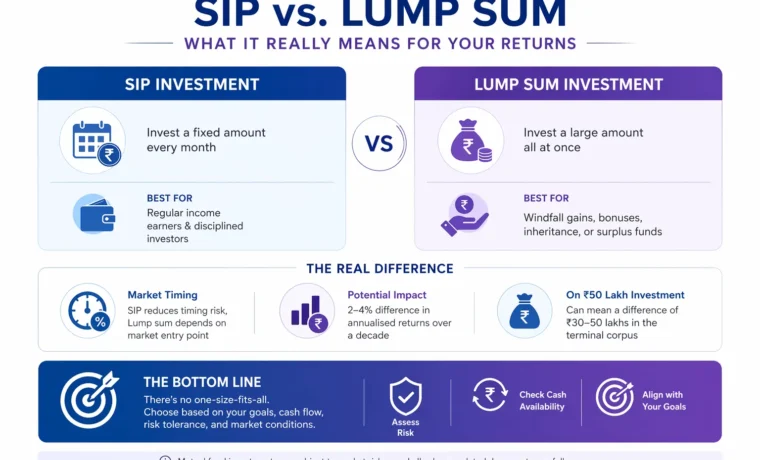
[link to related guide on SIP vs lump sum investing here]
FAQs
Can I really start a mutual fund SIP with just ₹500? Yes, most major fund houses and platforms allow SIPs starting from ₹500, and some even go as low as ₹100.
Is it better to invest in one fund or split ₹500 across multiple funds? At this amount, stick to one fund. Splitting ₹500 across three funds means each gets too little to matter and adds unnecessary complexity.
What returns can I realistically expect from equity SIPs? Historically, Indian equity mutual funds have delivered 10-14% annualized returns over long periods, though this isn’t guaranteed and varies by market cycle.
Should a beginner invest directly in stocks instead of mutual funds? Generally no — mutual funds offer diversification and professional management, which suits beginners better than picking individual stocks with limited capital.
How soon can I withdraw money from a SIP if I need it? Equity fund SIPs are generally liquid, but withdrawing within a year may attract exit loads and short-term capital gains tax.
Conclusion
Learning how to start investing doesn’t require a big paycheck — it requires starting, even with an amount as small as ₹500. The habit you build now, combined with gradual increases as you earn more, matters far more than the exact starting figure.
If you’ve been putting this off, set up that first ₹500 SIP this week rather than waiting for a “better” time that may never actually come.