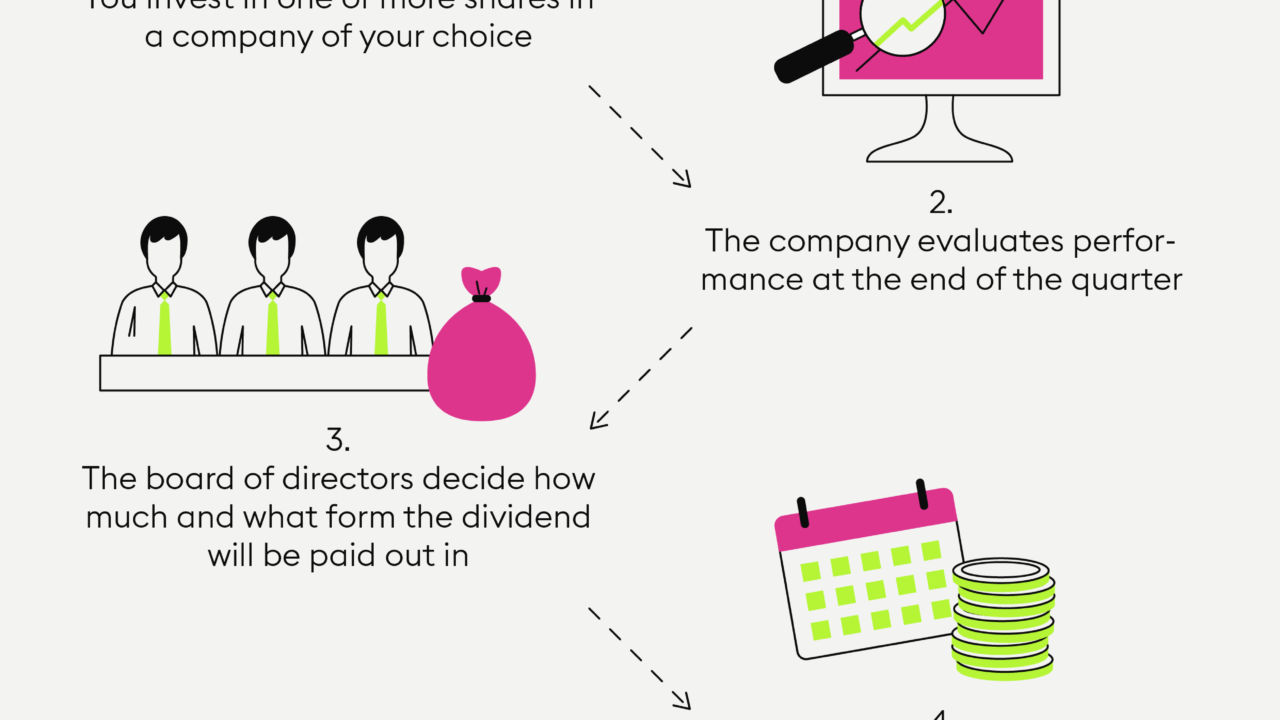
There’s something genuinely satisfying about seeing a dividend credit hit your bank account without having done anything that quarter except own the stock. It’s not going to make anyone rich overnight, but building passive income through dividends is one of the more sustainable, boring-in-a-good-way strategies available to long-term investors.
What Dividend Income Actually Is
A dividend is a portion of a company’s profit distributed to shareholders, typically paid quarterly, semi-annually, or annually. Companies with stable, mature businesses — rather than fast-growing startups reinvesting all profits — tend to be the more reliable dividend payers.
Growth companies often pay little to no dividend, reinvesting profits into expansion instead, which is why dividend investing usually points toward a different type of company than pure growth investing.
Key Metrics for Evaluating Dividend Stocks
Before building a dividend portfolio, a few numbers matter more than just the headline yield:
- Dividend yield — annual dividend divided by current stock price, expressed as a percentage
- Payout ratio — percentage of earnings paid out as dividends; very high ratios (above 80-90%) can be unsustainable long-term
- Dividend history — consistency over 10+ years matters more than a single good year
- Free cash flow — a company needs actual cash, not just accounting profit, to sustain dividend payments
[link to related guide on best mutual funds for long-term wealth here]
Sectors Known for Consistent Dividends in India
Certain sectors have historically been more reliable for dividend investors:
- PSU banks and PSU companies — often mandated to pay dividends to the government as majority shareholder
- FMCG companies — stable cash flows from consistent consumer demand support regular payouts
- IT services companies — many large IT firms maintain consistent dividend policies alongside buybacks
- Utility and power companies — steady, regulated cash flows often translate into predictable dividends
That said, sector trends shift over time, so this shouldn’t be treated as a permanent, unchanging list.
Building a Dividend-Focused Portfolio
Rather than chasing the single highest dividend yield stock, a more sustainable approach involves diversifying across 15-20 dividend-paying companies spanning different sectors, reducing the impact if any single company cuts its dividend due to business troubles.
A high yield alone can sometimes be a warning sign rather than a benefit — an unusually high yield sometimes reflects a falling stock price rather than a generous company, since yield is calculated against current price.
[link to related guide on how to read stock charts here]
Dividend Mutual Funds as an Alternative
If picking individual dividend stocks feels overwhelming, dividend-yield focused mutual funds offer built-in diversification managed by professionals. These funds pool investor money into a basket of dividend-paying companies, distributing the collected dividends periodically, similar to individual stock investing but with less hands-on research required.
Tax Treatment of Dividend Income
Dividend income in India is taxed at your applicable income tax slab rate, added to your total taxable income — this changed from the earlier dividend distribution tax system. For those in higher tax brackets, this can meaningfully reduce the effective yield compared to capital gains from stock price appreciation, which is worth factoring into your overall strategy.
Reinvesting vs Taking the Payout
In the earlier years of building wealth, reinvesting dividends back into more shares (either manually or through a dividend reinvestment plan) accelerates compounding significantly. Only in later years, particularly closer to or during retirement, does taking the actual cash payout as usable income typically make more sense.
Realistic Expectations on Returns
Average dividend yields for stable Indian large-cap dividend payers typically range from 1.5% to 4% annually. To generate ₹20,000 monthly (₹2.4 lakh annually) purely from dividends at a 3% average yield, you’d need a portfolio worth roughly ₹80 lakh — a number that illustrates why dividend income usually supplements rather than fully replaces active income for most investors, at least in earlier years.
Common Mistakes in Dividend Investing
- Chasing unusually high yields without checking if they’re sustainable
- Concentrating too heavily in one sector, like only PSU banks, increasing risk
- Ignoring the underlying business fundamentals purely because the dividend looks attractive
- Not accounting for the tax impact when calculating actual take-home dividend income
FAQs
Do all stocks pay dividends? No, many growth-oriented companies reinvest all profits into expansion rather than paying dividends, particularly newer or fast-growing businesses.
Is a higher dividend yield always better? Not necessarily — unusually high yields can sometimes signal a struggling company with a falling stock price rather than genuine financial strength.
How is dividend income taxed compared to capital gains? Dividend income is taxed at your income slab rate, while long-term capital gains from stocks held over a year are taxed at a flat rate, which can make a meaningful difference for higher earners.
Can dividend investing alone fund my retirement? It can be a meaningful component, but usually needs a substantial invested corpus to generate significant income; combining it with other income sources is generally more realistic.
Should beginners start with dividend stocks or dividend mutual funds? Dividend mutual funds often suit beginners better initially, offering diversification and professional management before transitioning to individual stock selection with more experience.
Conclusion
Building passive income through dividends is a legitimate, time-tested strategy, but it requires patience, diversification, and realistic expectations about the corpus needed to generate meaningful income. It’s less about finding one magic high-yield stock and more about steadily building a diversified, sustainable portfolio over years.
If you’re just starting out, consider beginning with a dividend-focused mutual fund before gradually building toward individual stock selection as your knowledge and portfolio both grow.